Hear Aberdeen’s perspective on building durable income through active allocation, global diversification, and disciplined risk management. In this CEF Insights discussion, Mike Taggart of Aberdeen Investments speaks with Jonathan Mondillo, Aberdeen’s Global Head of Fixed Income and lead portfolio manager of the Aberdeen Multi-Market Income Fund (MMT), about the fund’s transition under Aberdeen’s management and its role as a flexible, global fixed income strategy.
Transcript
CEFA:
Welcome to CEF Insights, your source for closed-end fund information and education, brought to you by the Closed-End Fund Association.
Thank you for joining us as Mike Taggart and Jonathan Mondillo of Aberdeen Investments discuss multi-market income funds.
Mike is Aberdeen’s Head of Closed-End Fund Investor Relations. Jonathan is Global Head of Fixed Income and Lead Portfolio Manager for Aberdeen Multi-Market Income Fund, ticker symbol MMT.
Mike Taggart:
Good afternoon, everyone, and welcome. Today, we're going to take a look at the investment strategy behind the Aberdeen Multi-Market Income Fund, ticker symbol MMT. That strategy is very broad. We're going to get an update on developed credit markets, global high yield, and emerging market debt from Jon Mondillo, nonetheless. Jon is the lead portfolio manager for this fund, and he's also Aberdeen's global head of fixed income. Jon, I appreciate that you've taken time to discuss the fund and the current fixed income markets with us.
Jonathan Mondillo:
Yeah, thanks for having me, Mike. Pleasure to be here, obviously, talking about this specific opportunity and going through some of those sectors that you touched upon, certainly how we manage a broad universe of opportunities and I think how we're going to deliver for shareholders over time in the multi-market income strategy. Thanks.
Mike Taggart:
Well, so you know, let's just get an obvious question out of the way. Aberdeen took over management of the fund in mid-June. At time we're recording this, about two months ago. So, you're now roughly two months into managing the portfolio. What did you inherit when you took over in June and what have you changed so far?
Jonathan Mondillo:
Yeah, listen, I think it's still early days. The first thing is that we inherited was a portfolio that I think needed to be moved from what we viewed as a legacy structure into really Aberdeen's investment framework. We're very focused on doing that quickly, but certainly not mechanically. I think the multi market income strategy as it exists today was a combination of three separate and distinct strategies that gave the fund certainly more scale. However, as the investments were overwhelmingly focused on lower credit quality, high yield names to the tune of 70 plus percent, and this is a multi-sector credit strategy, which is being run at an average investment grade credit quality, changes were certainly necessary. Now, I think the first priority was to really understand every one of the holdings that came over, assess whether it fit the new mandate, and move the portfolio towards the exposures that we wanted without creating unnecessary transaction costs as well as liquidity pressures. We've done this in the past, and I think we've been able to manage things appropriately with respect to those two things. I think the pace of the transition two months in has been deliberate but active. I think we focused on increasing the credit quality to investment grade, which we're quite proud of. We've reduced exposures or we've reduced positions that we don't think fit our forward-looking view. And we've really added to exposures where we see better compensation for risk. So, things like emerging markets debt, investment grade credit, as well as securitized and structured assets. So, a really a true multi-sector global income strategy versus what was ported over largely dependent on high yield. I think the last point that I would make and a very important one is for us that this was not just a relabeling exercise for us. We're applying Aberdeen's global fixed income process, our research platform, as well as our risk framework, which I think is equally as important. to really deliver this disciplined multi-sector approach.
Mike Taggart:
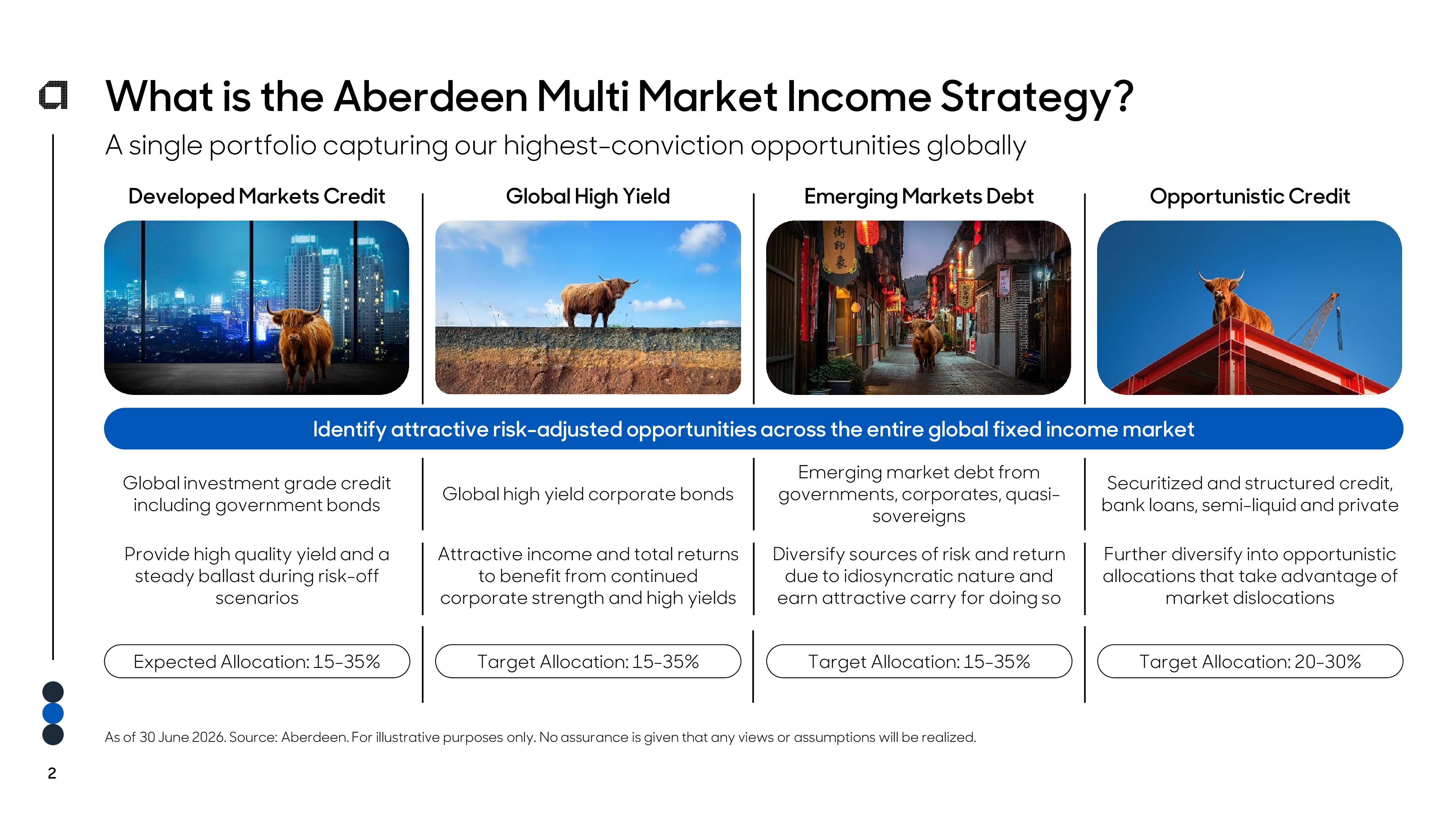
Well, Jon, I think we've already touched on a little bit of this, but the name of the fund is Multi-Market Income Fund. And we've been describing it to investors as having four major building blocks, developed credit markets, global high yield, emerging markets debt, and opportunistic fixed income. But for an investor looking at the fund today, how should they think about the role each of those four sleeves plays in the portfolio? Are you thinking about those as four relatively independent sources of income and return, or are you really managing them as one integrated portfolio, how's that working?
Jonathan Mondillo:
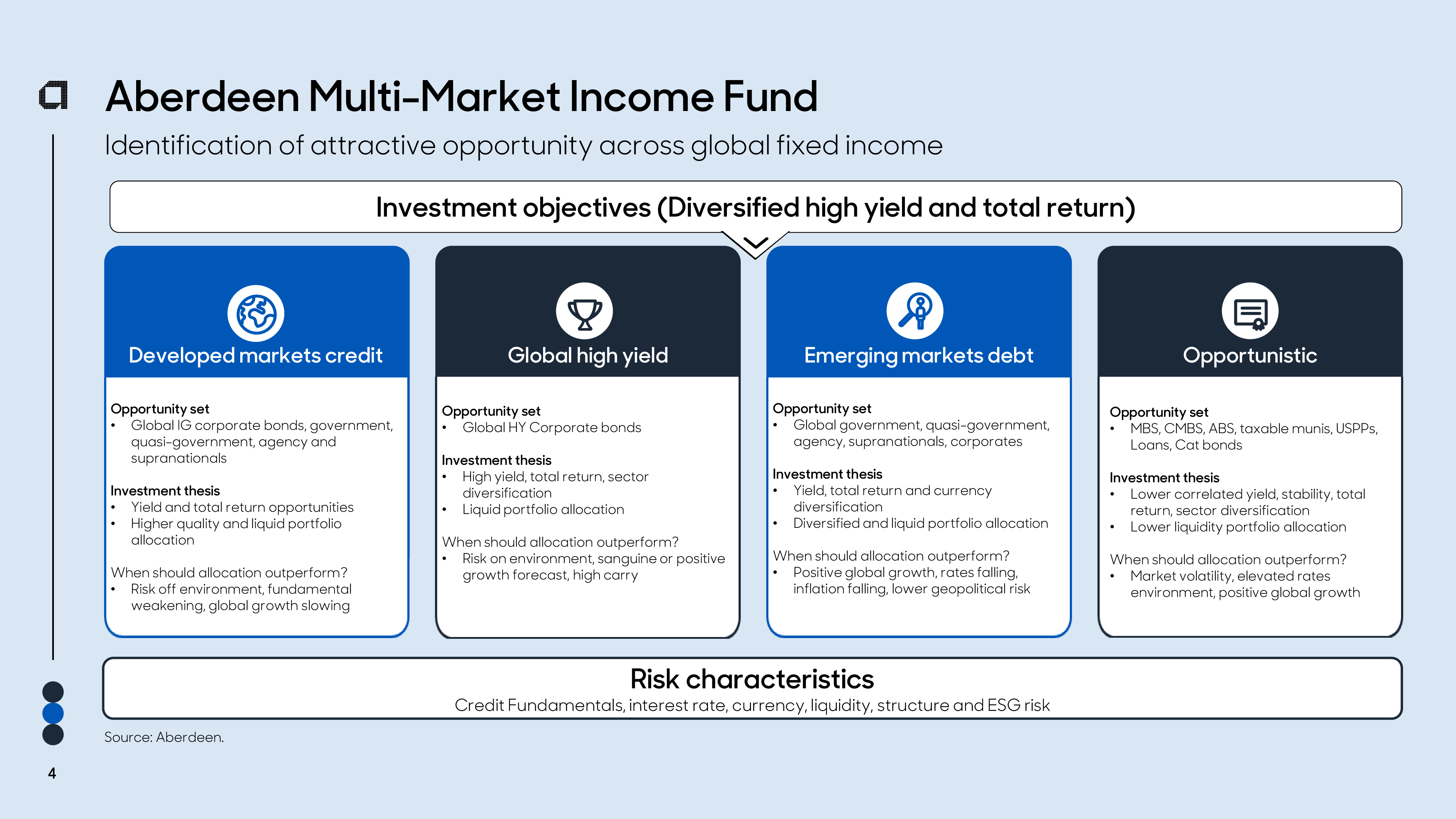
I mean, we think about the four sleeves really as distinct sources of both risk as well as return. But I'd say that we manage them as one portfolio. You've got, on the one hand, developed credit gives you sort of higher credit quality income. You've got liquidity. You've got sort of lower volatility characteristics when markets become much more defensive. You've got global high yield, which is where we can really capture attractive carry, as well as security selection alpha, i.e. capital appreciation, when corporate fundamentals are sound. You've got emerging markets debt, which adds significant diversification. Let's remember a lot of the drivers of return are often differentiated versus developed markets across things like countries, currencies, sovereigns, quasi-sovereigns as well as corporates. And you've got sort of the 4th leg to that stool, opportunistic fixed income, which gives us the ability to really access areas such as securitized credit, loans, selected private or semi-liquid credit. as well as other less benchmark driven opportunities. But I think the one key point that I would point out is that we're not trying to run four separate funds inside of just one structure. We're asked one integrated question when we designed this strategy, which is where across the global fixed income universe are we really being paid most on a risk adjusted basis? And I think in practice, that integrated approach really works in two ways. I think within each sleeve, portfolio managers maintain regular dialogue on individual opportunities, i.e. bottom-up security selection decisions. And then on a top-down basis, across those sleeves, we rebalance at least quarterly using some of the macro framework as well as relative value work to determine really where the portfolio's risk budget is best deployed within those four sleeves.
Mike Taggart:
Well, I want to come back to that in a minute. But let's kind of go more into the process. But sticking kind of with investors, right? So, investors have an enormous number of fixed income choices available to them today. What do you think this fund can do for an investor that a traditional core bond portfolio or a simple high yield portfolio can't do?
Jonathan Mondillo:
I mean, I think it's twofold. One is differentiation. There's that componentry of semi-liquid or less liquid that we have available to us on our fixed income platform globally. And then the second really is flexibility. So, a traditional core bond portfolio is really usually dominated by things like government bonds, agency-backed MBS, as well as investment-grade credit. So certainly offers diversification, but to your point, may not offer enough income. I think a simple high-yield portfolio certainly can provide that income, but it's much more concentrated in really one type of credit risk. This fund, on the other hand, is designed to be very broad. It looks across things like rates or sovereign bonds, investment grade credit, high yield as well as emerging markets, and securitized assets. And it can allocate to sort of areas of that private credit space that maybe you don't get in your open-ended vehicle or you're in core allocation. So really seeking to find those best risk-adjusted returns across a very broad subset of fixed income asset class. Now that matters because fixed income markets are not always static, right? You'll have periods of time where you want to be up in credit quality, you want to be short in duration, and vice versa. You're going to want to have periods of time where you have access to things like lower liquid asset classes, high yield and emerging markets debt. So, the best opportunities today may not be the best opportunity six months from now. And this portfolio is intended to give investors that diversified income, active sector allocation, and really best-in-class bottom-up security selection in one vehicle. You know, for investors that are looking for an average investment grade credit quality and a yield, distribution yield that is of 11%, we think this strategy offers a very compelling opportunity.
Mike Taggart:
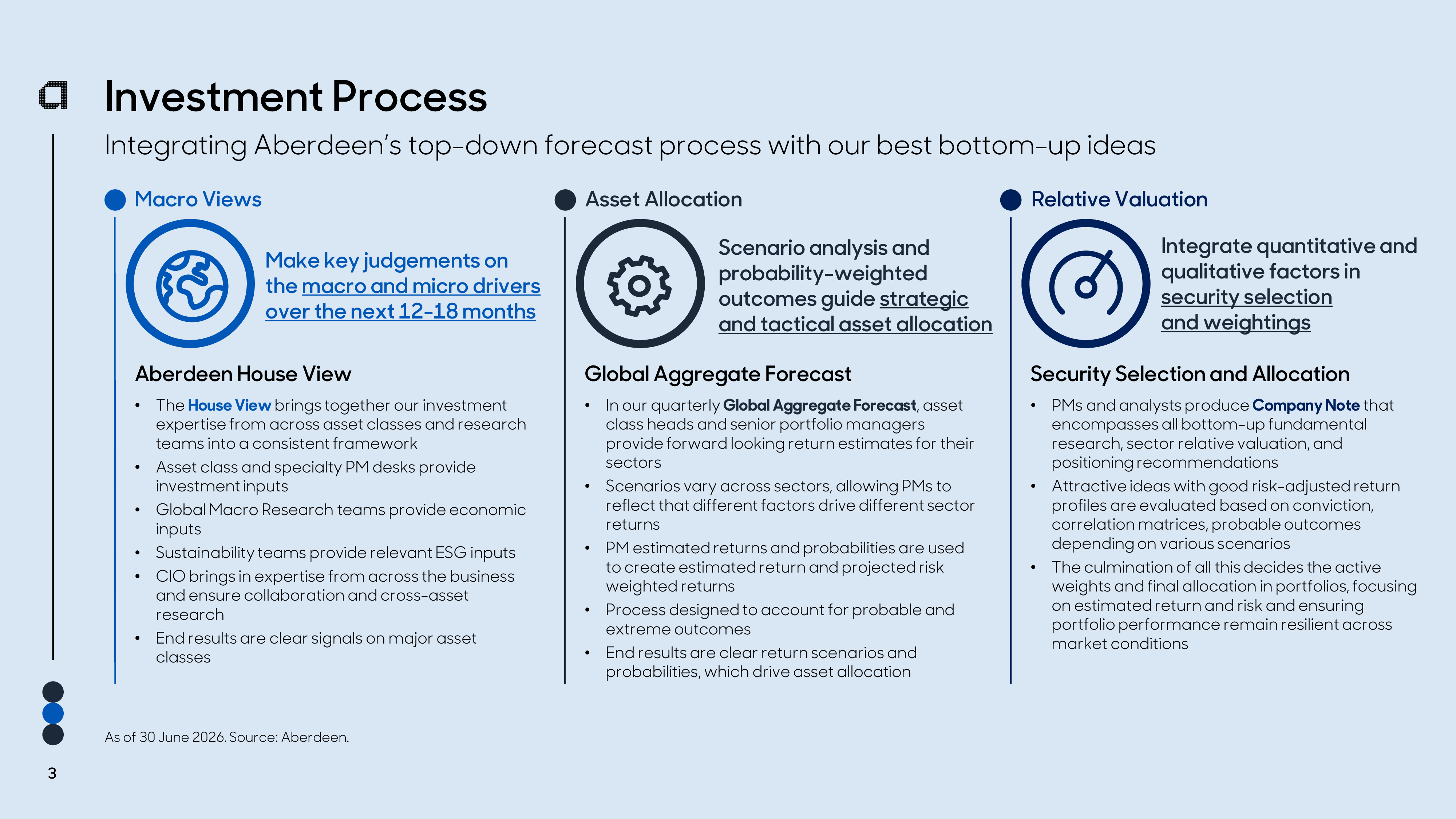
Right. So let's get into that process a little bit and kind of what the state what the current state is of these various factors that you were mentioning. So, you know, we've put out materials about how we're going to manage this fund. Three stage process, the macro environment, fixed income sub asset classes that you've kind of mentioned, and this relative value, which I guess is the risk adjusted value, right? So, when you sit down with the team today, what are the two or three macro variables that matter most to how you're positioning the portfolio?
Jonathan Mondillo:
Yeah, that's the secret sauce, Mike. That's a big question.
Mike Taggart:
We're not going to give away the answer.
Jonathan Mondillo:
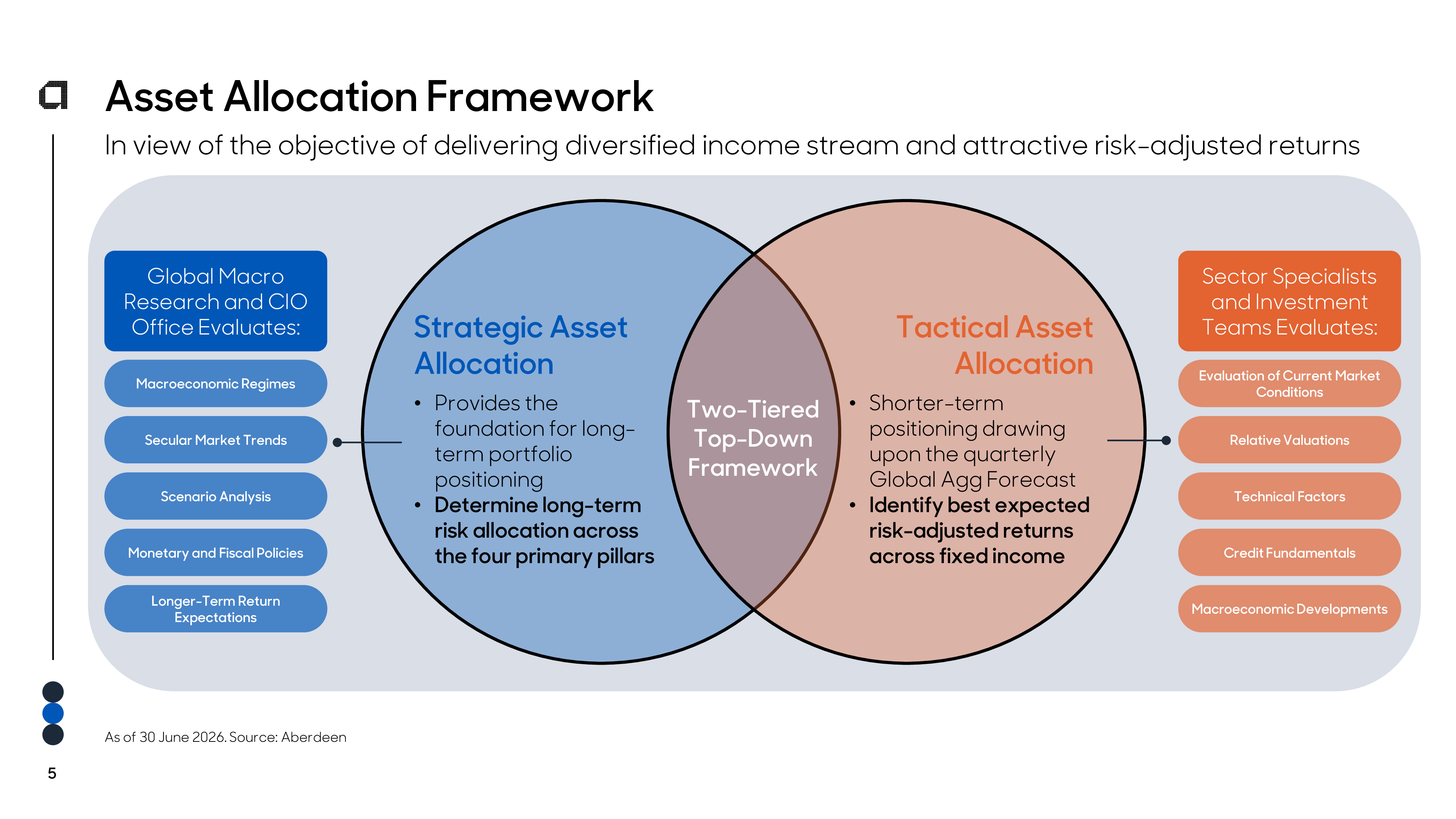
No, gladly give a little insight into how we manage things from a top-down asset allocation perspective. You'd mentioned that three-stage process. I'd say that starts with a two-tiered top-down asset allocation framework. We've got the strategic asset allocation framework, which is really foundation for the portfolio's longer-term positioning, upwards of three years in portfolio positioning. That work's really driven by our global macro research scenarios, as well as the CIO-led house view process that we have here at Aberdeen, which really brings together a number of different things. One being sort of macroeconomic developments backdrop, secular market trends, monetary and fiscal policy, as well as scenario analysis that the global macro research team goes through. Now, the output helps us determine, as I said, that longer risk allocation across those four primary pillars of the fund and really drives what the portfolio should look like, not today, but over the next three years. I think we then complement that top-down view with what we characterize more so as a tactical allocation process, which is more focused on the next three to six months. Now, that shorter term positioning draws more heavily on our quarterly global aggregate forecast, where we've got asset class heads as well as senior portfolio managers that provide forward-looking return estimates within their subsectors under a base upside and downside scenario, and then asign probabilities to those outcomes. Now, what I think that gives us as opposed to that tactical asset allocation or that strategic asset allocation, rather, is it gives us a structured way to evaluate not only the long-term objectives and where we want the portfolio to be positioned, but what do current market conditions look like? What do relative valuations look like? What are technical factors that are driving credit fundamentals and identify where expected rich adjusted returns look most attractive across fixed income today, i.e., where do we want the portfolio allocations to look like over the next three to six months? I think the combination of those two is really important and certainly unique from what we've seen in the competitive landscape. We've got that GMR scenario work that anchors that strategic direction for the portfolio over the next three years. or longer. Well, that global ag forecast helped us decide really how much risk to take today and where to express that in a tactical way.
Mike Taggart:
So, you know, where are you finding the most compelling opportunities in fixed income right now? Not necessarily the highest yields, but where do you think investors are being best compensated for the risks they're taking? Is that primarily in credit, you know, like the spreads there? Is it duration, emerging markets? Your purview here is quite large. It's pretty much go anywhere.
Jonathan Mondillo:
Yeah, it is a go anywhere fund, right? I mean, relative value is really the bridge between our top-down view, which we just went over, and how the actual portfolio looks. I think we may like credit generally, but that doesn't necessarily mean that every part of the credit market is attractive. So we compare things like sectors, regions, ratings, as well as maturities, things like structures and individual securities. I think we ask whether the spread compensation compensates us for things like default risk, downgrade risk, liquidity risk, structured risk, and then what's been more pertinent over the last several months, things like volatility. I think we also compare things like public markets versus private opportunities, developed versus emerging markets, as well as where you are in the capital stack, senior secured versus unsecured or tier 2 securities. Again, this process is intended to be repeatable. You've got that macro backdrop providing a broad direction of the fund. You've got that sub-asset class work that really narrows down that opportunity set. And you've got that relative value determination, which helps guide where we actually want to spend the majority of the portfolio's risk budget. I think at the moment, as we said, the transition of this portfolio has been up in credit quality. Part of what drives that is the prospectus language, right? We have to maintain that average investment grade credit quality. But also too, when we look at where credit spreads are, when we look at broad valuations, probably not a bad time to be a little bit up in credit quality. In addition to that, the diversification that it offers, getting into things like emerging markets, diversified versus what's traditionally been a primarily developed markets opportunity set. And then into things like securitized assets, CLOs, to name one, look really attractive relative to investment grade credit markets for the moment, just to name a couple attractive opportunities.
Mike Taggart:
So, you mentioned volatility as a factor and this fund uses leverage. So, which obviously then heightens volatility to the upside and to the downside. When you manage the fund at the portfolio level, how are you thinking about the effects of leverage on investors who are investing at the net asset value level?
Jonathan Mondillo:
Yeah, listen, leverage can be a useful tool. I think in a normalized bond market, certainly adds to things like income generation. We do use leverage in the strategy and we'll continue to do so, but it'll be actively managed. I think for shareholders, returns are experienced at the net asset value level, like you said. So, it certainly can amplify things like income, but it also amplifies things like volatility. And we've seen the results of that over the last, let's call it 12 to 18 months where rates volatility has far eclipsed things like credit spread volatility. So we manage it as part of a total portfolio risk budget, not really as an afterthought, it's not a set it or forget it, we actively manage, typically within our closed-end fund strategies, as well as this one on a go-forward basis, where that leverage amount is relative to the underlying assets of the fund. I think this means looking at the cost of leverage, the yield as well as the spreads available on the assets that we buy with it, the liquidity of those assets, as well as how the portfolio behaves in a risk-off environment. So we want leverage there to support those income objectives, but we don't want to force bad decisions in a stressed market. So emphasizing things that maintain that diversification, maintain high levels of liquidity, as well as enough quality in the portfolio that the use of leverage is really consistent with the fund's risk profile, as well as that shareholder experience, which I'm sure you're most focused on, Mike.
Mike Taggart:
Yeah. Try to focus solely on the shareholder experience and myself. So, speaking of shareholder experience, you brought up income before you mentioned it. Obviously, that's a central reason investors own this fund. The strategy is designed to generate a high level of current income. Now the fund has a managed distribution policy in place. It's 11% of the previous month's NAV annualized. So when you're constructing the portfolio, you've talked about risk adjusted returns, you're selecting the individual securities. How much do you weigh the securities yield versus its risks versus its capital appreciation potential in your judgment of whether or not to invest?
Jonathan Mondillo:
Yeah, listen, yield certainly matters. I think income is central to the strategy, but for all intents and purposes, yield by itself is never enough. I think we want to understand things such as the source of that yield. Is it compensating for things like credit risk, for things like liquidity risk? Could be something like convexity risk, duration, currency, or something else. I think then we judge whether we are being adequately paid. I think a security with a high coupon can certainly be attractive, but it could also be unattractive if things like downside risk is too large or capital structure or covenant language is too weak. Then conversely, a somewhat lower yielding security could potentially be quite valuable, particularly if it has strong downside protections, things like good liquidity and potential for spread tightening or price appreciation. So the decision really is a balance of that income that we touched upon, yield, total return as well as risk downside protection. I think what we're trying to build here with the multi-market income strategy is an income stream, but an income stream that's durable and not one that simply reaches for the highest headline yield.
Mike Taggart:
Right. So it kind of feeds directly into your focus on expected risk adjusted return, right? If there's a compelling expected risk adjusted return, odds are that the yield on that security is going to be attractive and something you're going to want to invest in. So they kind of work hand in hand. Is that kind of the case in a nutshell?
Jonathan Mondillo:
Yeah, absolutely. But it's not as simple as picking the higher number by any means.
Mike Taggart:
No, for sure. That's what I mean. It's like risk adjusted, right? Sometimes this thing's offering this crazy yield and there's a really good reason for it. It's because there's risks off the charts, right? We're not going to buy that, I think is what I hear you say. We're going to buy things where it's an attractive yield given the risk involved.
Jonathan Mondillo:
And you see that in sort of the lower echelons of, say, the high yield space, right, where you've got high yielding opportunities in the sort of lower B rated or triple C rated names. But as we've seen over the past several months, they've underperformed quite significantly despite those yields. You've seen periods of time where liability management exercises have really driven haircuts in that space. So it's not as simple as picking the higher number. And we certainly think that active management in this space across those four verticals and a global approach to things is going to create better risk adjusted return profile on a go forward basis.
Mike Taggart:
Exactly. Okay. And then finally, if you had to leave investors with one thing they should understand about the way you're managing this portfolio, what would it be?
Jonathan Mondillo:
Yeah, I'd emphasize what I just said, right? So active, integrated global fixed income portfolio. We're not simply buying yield. You know, we're not simply anchoring the fund into this static allocation. We're using Aberdeen's global research platform to identify where income is most attractive after adjusting for risk. We're prepared to move the portfolio as that relative value changes. The objective is to deliver high level of current income, but really to do so in a disciplined manner around things like fundamental, around things like valuations, around things like liquidity and downside risk.
Mike Taggart:
Excellent. Well, Jon, I think that's a good place to leave it. Thanks again for taking the time to give us a look inside the portfolio and your investment process and how you think about all these.
Jonathan Mondillo:
Right, right. So as that spread widens, it becomes more fruitful to utilize leverage, which has been the trend really over the last two years. It's become wider and wider where the curve was relatively flat a couple of years ago. It's become steeper. So, I think it's a good environment really to add leverage at this point.
Mike Taggart:
Excellent. Well, Miguel, thank you for taking the time today. Appreciate your insights into the Aberdeen Municipal Income Fund. And thank everyone for taking the time to learn more about the Aberdeen Municipal Income Fund.
Jonathan Mondillo:
Thank you, Mike. Appreciate the opportunity.
Mike Taggart:
And to everyone in the audience, thank you for taking the time to join us today.
CEFA:
Thank you for joining us for another episode of CEF Insights. For more CEF Insights, videos, and podcast episodes, please visit CEFA.com, your independent source for closed-end fund education data and insights.
Video recorded August 2026.
Disclosure
Past performance is not indicative of future results.
This commentary is for informational purposes only, and is not intended as an offer or recommendation with respect to the purchase or sale of any security, option, future or other derivatives in such securities. Any research or analysis used in the preparation of this document has been procured by Aberdeen Investments or its affiliates for their own use and may have been acted on for their own purpose. The results thus obtained are made available only coincidentally and the information is not guaranteed as to its accuracy. Some of the information in this document may contain projections or other forward-looking statements regarding future events or future financial performance of states, markets or companies. These statements are only predictions and actual events or results may differ materially. The reader must make his/her own assessment of the relevance, accuracy and adequacy of the information contained in this document and make such independent investigations, as he/she may consider necessary or appropriate for the purpose of such assessment. Any opinion or estimate contained in this document is made on a general basis and is not to be relied on by the reader as advice. Neither Aberdeen Investments or any of its agents have given any consideration to nor have they made any investigation of the investment objectives, financial situation or particular need of the reader, any specific person or group of persons. Accordingly, no warranty whatsoever is given and no liability whatsoever is accepted for any loss arising whether directly or indirectly as a result of the reader, any person or group of persons acting on any information, opinion or estimate contained in this presentation. The information herein including any expressions of opinion or forecast have been obtained from or is based upon sources believed by Aberdeen Investments to be reliable but is not guaranteed as to accuracy or completeness. The information is given without obligation and on the understanding that any person who acts upon it or otherwise changes his position in reliance there on does so entirely at his or her own risk. Aberdeen Investments reserves the right to make changes and corrections to its opinions expressed in this document at any time, without notice. Any unauthorized disclosure, use or dissemination, either whole or partial, of this presentation is prohibited and this presentation is not to be reproduced, copied, made available to others. Fixed income securities are subject to certain risks including, but not limited to: interest rate (changes in interest rates may cause a decline in the market value of an investment), credit (changes in the financial condition of the issuer, borrower, counterparty, or underlying collateral), prepayment (debt issuers may repay or refinance their loans or obligations earlier than anticipated), call (some bonds allow the issuer to call a bond for redemption before it matures), and extension (principal repayments may not occur as quickly as anticipated, causing the expected maturity of a security to increase). Historical data and analysis, should not be taken as an indication or guarantee of any future performance analysis forecast or prediction. Such information is basis and the user of this information assumes the entire risk of any use made of this information. In the United States, Aberdeen Investments is the marketing name for the following affiliated, registered investment advisers: Aberdeen Standard Investments Inc., Aberdeen Asset Managers Ltd., Aberdeen Standard Investments Australia Ltd., Aberdeen Standard Investments (Asia) Ltd., Aberdeen Capital Management LLC, Aberdeen Standard Investments ETFs Advisors LLC and Standard Life Investments (Corporate Funds) Ltd. © Aberdeen Group plc 2026 ID: AA-220626-209669-1 aberdeeninvestments.com